Shrimp salad


You see this in Mexico a lot and infrequently in authentic Mexican restaurants here in the U.S., usually in tall parfait glasses with shrimp suspended in a pink or red liquid. Ordered as shrimp cocktail, it differs significantly from the dish as it's usually prepared here in the U.S, with shrimp hanging over the rim of a cocktail glass containing a tomato base with horseradish sauce and known familiarly as the red menace. In Mexico, it might be noticed at an adjoining table at a cantina on the beach, and freshly warned about drinking the water, the cautious traveler hesitates. And that's a shame because the cautious traveler misses out on a real treat that much of Mexico has to offer -- seafood fresh off the boats.

Oh well.

Now you can enjoy this treat in the safety of your own home. Impress your friends and guests with your world-traveliness and your brilliant culinary éclat. This is usually served with tortilla chips, but we're leaving them out because we're presently restricting carbs from grain. Therefore, it's served over a bed of lettuce sprinkled with olive oil and drizzled with rice vinegar.

Did you know parfait means perfect in French? Well it does.

* couple pounds cooked shrimp, peeled and deveined
* couple cloves crushed garlic
* 1/2 large red onion chopped (or scallions, or leeks)
* lots of fresh cilantro, picked apart, torn, whatever
* 1 1/2 cups Clamato™, or clam juice with diced tomato)
* 1/4 cup tomato paste or tomato pesto, or catsup in a pinch
* juice from one good juicy lime, or two not so juicy limes
* 1 teaspoon hot pepper sauce, or to taste, your choice, Tabasco, Franks, habanero, whatever
* 1/4 cup prepared horseradish or grated horseradish root
* salt
* 1 or 2 ripe avocado

Mix everything. Avocado last and gently. Chill for a few hours.

Consider possible extras.

+ jalapeño finely diced
+ splash of tequila, vodka, as a Bloody Mary.
+ Worcestershire sauce, as a Bloody Mary.
+ cucumber diced
+ diced celery
+ mango diced

Serve with tortilla chips, or on lettuce as a salad.

Venison meatballs

Hey, you dad gum varmits, quit look'n at mah dad gum meatballs!


Salad with garden tomatoes given to me by friends.
Dressing = raspberry vinegar whipped with vegetable oil and raspberry preserves and Dijon style mustard, salt/pepper.

Sauce on the meatballs is a commercial Tuscan vodka sauce. It's not that great. I'm only using it to get rid of it and because I don't have any pesto. Almost anything else would have been better.

Meatballs, below.


Frame 1. I was given two packages of ground game and told what they were, but now I forgot. This package of meat is either venison or elk. Possibly moose or reindeer. Maybe caribou or polar bear. Oh, I don't know it might be narwhal or penguin. OK, now I'm sure, it's venison. The guy who gave me the venison shot the deer with his own two hands. And a gun. But mostly with a gun. Then dragged it out of the woods with a pack of snarling howling threatening wolves circling around him, dashing in and out trying to get him to drop the deer, but he wouldn't give in. Then when he finally got to civilization he gutted it and cleaned it. Then butchered the meat grinding portions of it and packaged it himself. Then made moccasins and belts out of the leather, sold them, and donated the profits to native special needs children living on reservations. OK, I made up that whole last part after the shooting it.

Frame 2. The green stuff is chopped spinach. The orange stuff is bell pepper. Crumbly stuff is sourdough breadcrumbs I made from bread that wasn't quite stale but too far gone to eat otherwise. That stuff doesn't last long because it doesn't have any preservatives. I'm lazy and I'd prefer to load the meatballs up with vegetables, that way I don't have to cook them separately. Tricky, eh? Actually, I just wanted to moisten and lighten the meatballs. Venison is exceedingly lean, and meatballs can be tight, so all this stuff loosens them up. A lot. They're very tender. I like my meatballs round and not flattened out. I'm a bit neurotic about that. So I boiled them first, to stiffen them up a little. You can eat them just like that. They're delicious. But boiled meat? Bleh. Lacks the interesting chemical complexity roasted meat undergoes.

Frame 3. Basil and parsley, grown at home.

Frame 4. Boiling meatballs.

After getting this far, with the first batch, six at a time, I realized I forgot salt and pepper. Duh! So I added it to the remainder of the mixture, along with a little habanero flakes, to kick it up.


OK, now that picture of a meatball sitting in a bowl of olive oil up there is pure art, and I don't care who ya are.

Drained, rolled in olive oil, then baked. Drenched in olive oil like this gives the oven something to toast and a medium to carry flavor. Added vegetable oil to substitute for animal fat that venison lacks. Fat is flavor. Alcohol also carries flavor, so adding beer would do the same thing. The vegetables were finished with wine before mixing with the ground meat. So there's that. This idea works for lean beef hamburger too. Better to ingest olive oil than animal fat. You know, cholesterol, and all that. They were drizzled with even more olive oil right before baking, so those pans were really sizzling.

I made an outstanding mess of the kitchen. That one pound of venison produced 27 meatballs, and I intend to eat every one. Unless somebody comes over and I generously toss them one.

Coffee

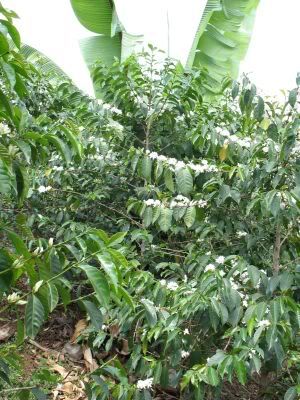
Coffee is a stimulant beverage prepared from the ground up roasted seeds found within coffee berries produced by several species of evergreen bushes of the genus Coffea, the two most common being Coffea arabica and Coffea canephora, in the family Rubiaceae, also known as madder, bedstraw, as well as the plain ol' coffee family. Other common plants of Rubiaceae are noni, ixora, partridgeberry, gambier, cinchona, sweet woodruff, and gardenia. A number of traditionally accepted families are now incorporated within Rubiaceae folllowing research by by some highfalutin arcane scientific research group, but I digress.


Sort of scraggly looking.

The important thing here is to know what you're drinking.

Coffee, of course, contains caffeine.

Caffeine is a bitter alkaloid.

An alkaloid is a naturally occurring chemical compound that contains a clump of nitrogen atoms. The name is derived from the word alkaline meaning base PH, meaning opposite of acid. It's produced by a variety of organisms including bacteria, fungi, pants, and animals and that's pretty much everything, then, inn'it? Many alkaloids are toxic. They often have pharmacological effects, they're used in medications and for recreational drugs. (Once, I used that phrase 'recreational drugs' in a sentence at the Federal Reserve Bank in conversation with this guy who was quite old, and he goes, "What?" And I go, "What, what?" And he goes, "Jesus Christ, I never heard that before.")

Examples of alkaloids are quinine, morphine, nicotine, cocaine, local anesthetic and caffeine. Some are bitter.

Here, I animated a little chemical picture of caffeine for you.

<


Embiggerated version here.

You're supposed to notice the nitrogen atoms clumped together there in the middle with all the little hydrocarbons and a few individual oxygens hanging onto it. Now, imagine them spinning around all crazy like and connected to a bunch of other molecules just like themselves. And then breaking down in your stomach into other simpler molecules jazzing you all up and getting all up on your nerves.

So, after all that, now you know that coffee is a bitter alkaloid and what an alkaloid is, you can impress your friends, win the admiration of your peers by saying things, perhaps to your secretary or to a waitress, "Hey, Pumpkin, will you please pour me a cup of bitter alkaloid? And make it snappy, Beeyotch, I ain't got all day." You know, lay on the charm.

~~~~~~~~~~~~~~

And now for the perfect cup of coffee.

You coffee elitists with your $2,000 espresso machines will probably not be interested in this so just skip the rest of this message, and have a good day. You also might not appreciate this if you own a French coffee maker that you're in love with, which can also be used for other things, like brilliantly filtering broth into a most excellent consume. However, open minded coffee drinkers agree, they've simply never tasted a more delicious cup than that devised by the nerds who sit at their computers all day with a ceramic mug badly in need of a scrubbing, and set their fevered imaginations to the problem of producing the perfect cup of joe. Here's the thing, as a bitter alkaloid, the idea is to have the ideal temperature water (170℉) come into contact with the grounds for no more than a few seconds. Why so short? Because the longer the bean grounds leach into the water, the more bitter the liquid becomes. You want the taste of the grounds to be imparted into the water, and not all that bitter crap that makes most coffee so gross. This requires a bit more grounds than you're used to using. Some people don't like that.

Step 1. Forget about Starbucks. They're deplorable. They know what they're doing but they use bad beans. I bought a sack of Starbucks beans, brewed a few pots and gave the rest away. Almost tossed them just to ensure I didn't inflict the harm on anybody else. Turns out, somebody actually wanted them. The thing that makes Starbucks beans bad, if you were to dump them out onto the counter, you'd notice uneven roasting. One out of every 100 or so beans is much paler than the rest, didn't roast properly because it was a bad bean to begin with. This one bad bean in a 100 ruins the whole batch. This Fair Trade crap is for guilt-ridden losers. Invites corruption and incompetence through the spirit of humane justice. You're being played.

The AeroPress makes any ol' reliable household coffee grounds into extraordinary cup of coffee. You can buy extravagant coffees from coffee boutiques if you wish, and many do, but I see no point to it. Especially since you use more grounds than you do with deeply steeped percolated coffee.

Here's how to use the AeroPress to produce a perfect vanilla latte in twenty easy steps. Ha ha ha ha ha. I never said perfect coffee was uncomplicated or easy. It's always such a mess. You might consider switching to tea, or even a cup of miso, which would be 100 X better for you.

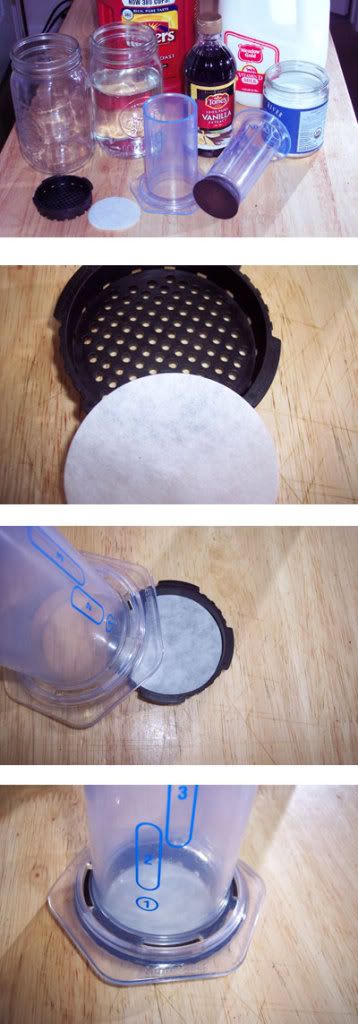
Here's all the crap you need to start off.

I love those cute little filters. It's just a paper disc. Fits into the black base which screws onto the bottom of the outer tube. There are two tubes, one is a plunger. There remains a gap of air between the coffee grounds and the rubber plunger, thus the name AeroPress.


The device produces a cup of espresso up to four cups. For an American style cup of coffee, dilute the espresso with heated water. That sounds like a bummer dun'it? It's not. Pure water into strong espresso = American coffee. Wouldn't do to run all that water through the coffee grounds picking up all that bitterness. This is what distinguishes the perfect cup of coffee from an imperfect cup of coffee.

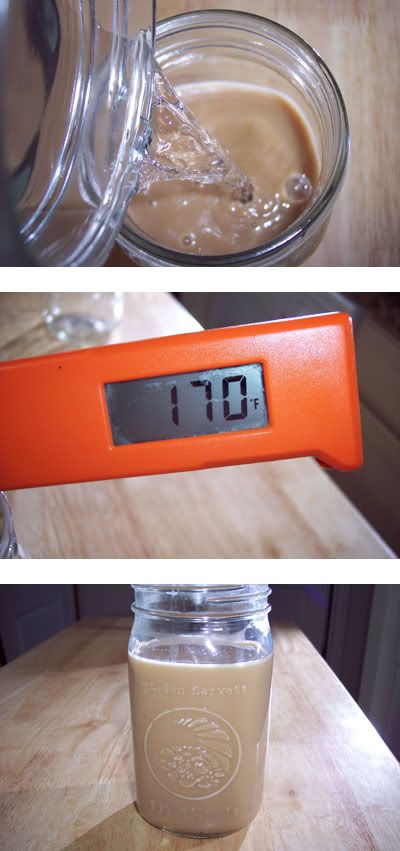
I use two mason jars. Using one of the jars, heat the total amount of water in a microwave to 170℉ . Meanwhile, using the other mason jar, prepare the vanilla latte ingredients, which are milk, sugar, and vanilla. Just dump them in.


Place the outer tube with the filter on top of the mason jar and add the coffee grounds. This is a shock to first-time users, the amount of coffee seems excessive. But remember, the hot water will have contact with the grounds only briefly, so you'll need more than you're in the practice of using. (If you've ever bought those pre-packaged coffee plug filters for your two million dollar espresso machine, you'll know what I mean. They do the same thing, that is, shove water through the grounds-filter quickly and once.) Pour in enough water to produce a cup of espresso. In this case, I'm making three cups worth. That was two scoops of coffee grounds which would be more than enough for a very large pot of coffee percolated the ordinary way to turn quite black.

Oh man, that reminds me. When I visit Mom, they have a huge coffee ewer percolating away for hours in the lobby. People keep going up to it and pouring themselves a cup of coffee. They have the usual set up, packages of sugar, little containers of powdered cream. Yuk. All that coffee recirculated through the grounds getting stronger and stronger. My stomach growls sympathetically every time someone pours a cup. I keep imagining the rock-gut hazardous waste they're pouring into themselves. They have no idea what real coffee is supposed to taste like, otherwise they would reject it outright. Although, the whole lobby does smell wonderful. Like burning coffee incense.


Plunge the water through, unscrew the base of the outer tube and push the filter with the compressed coffee grounds into the trash. Plop. That's the fun part of the whole thing. Gone. Just like that.


If you're a puss like myself and can not tolerate espresso-strength brew, pour in the remaining water. Viola! The perfect, and I mean perfect cup of sweetened vanilla latte. People who watch me make this say, "Boy, you sure drink coffee differently than me." Ha ha ha ha ha ha ha ha. To each his own, Dude.

I suppose you could pour it into a mug if you felt like being, you know, civilized, but I drink my perfect vanilla latte right out of the mason jar, 'cause I got no class. Also, it goes cold by the time I get half way through so I re-heat it. Then it goes cold again so I keep doing that, sometimes throughout the day. It never goes sour or bitter, it just keeps getting better and better with each re-heating. Tastes almost chocolaty. I do not understand this, but it does.

Videos available on YouTube, BoingBoing, and the AeroPress website if you're interested in watching someone use this. I bought a few AeroPresses for gifts. One person didn't appreciate the gift and presumably gave it away or just shelved it, the other person loved it to death, told a bunch of other people, a few who bought their own and themselves fell in love with it. It does make a good gift for a coffee lover who doesn't already own an elaborate machine and is willing to try something new.

Miso, chicken, vegetable soup

Frame 1

Jiggly, Jello-like, chicken aspic broth base.  This is what distinguishes home-made chicken broth.  The chicken bones were crushed with pliers exposing the marrow to the broth.  Pressure cooking guarantees every molecule of chickeny goodness is extracted in a short period of time.  No more of this boiling for hours.  I'm not even sure that's necessary to get out the marrow.  I suspect it passes readily right through the bones, but I'm not sure.  No root vegetable, no aromatics, no spices and absolutely no salt.  Just chicken juice.  But, every last bit of chicken broth including the pan drippings and fond resulting from prior roasting, thus taking advantage of the Maillard reaction.  Don't believe me?  Go on then, look it up for yourself.

So there's that.

Frame 2

Four pound bucket of sweet miso.  Only a few tablespoons was used here. This hasn't been fermented for very long -- only  a few months. Contains less salt than long-fermented miso -- fermented at least a year up to four years.  The longer miso ferments, the more salt is added along the way.  This results in miso too strong for my particular taste.  You might like it better.  They all taste different depending on the grain used to ferment and the length of time spent fermenting.  Presently, I like mine mild.   I bought this Four pound container because I'm tired all the one pound containers sliding around my refrigerator.  I expected it to last all winter.  It's lasted less than a month.  Therefore, I've ordered eight more pounds.   But I started running out before my new order arrived, so I opened two cans of garbanzo beans, drained them, and mixed them into the remaining miso in the bucket hoping the miso would inoculate and miso-ify the garbanzo beans.  I left the bucket on the counter. I think it worked, but I'm not sure.

Frame 3

Soup ingredients include a home-grown tomato given to me by friends, and a small handful of noodles also given to me by friends.  Inn't  that nice? Lots of baby spinach, celery, onion, garlic, and more jalapeño peppers.

Frame 4

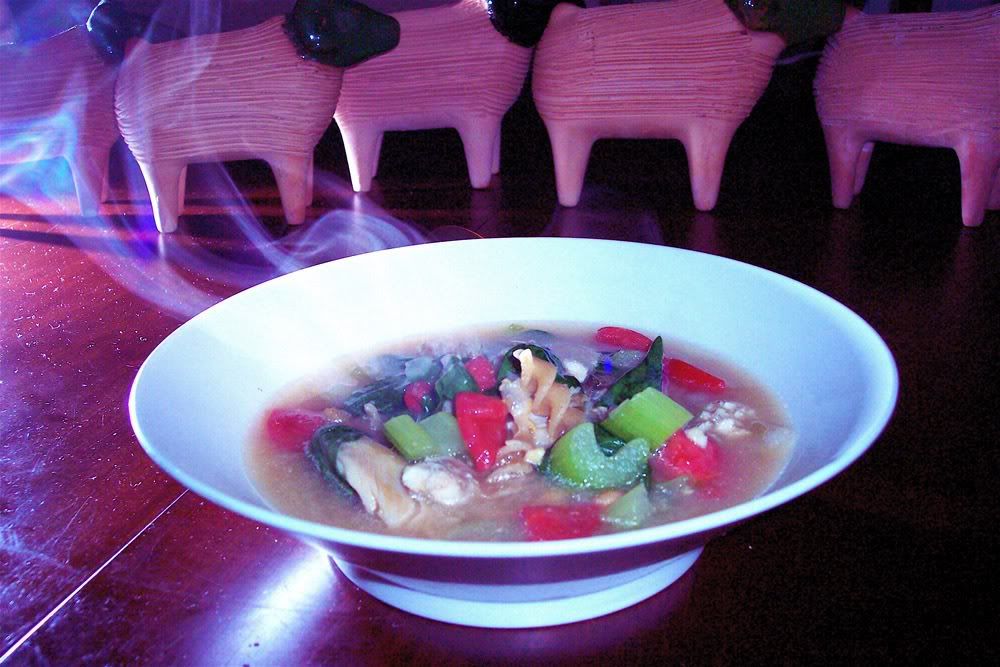
Oh noes!  A herd of chia rams are cirkalin' mah soupz !

Here's a thing about miso I read in a book.

Maybe, possibly, sort of, could, might, subjunctively, perhaps, mayhap, prevent radiation sickness. No shit. A hippy wrote the book so it must be true ! 

Dr. Shinichiro Akizuki, director of the Saint Francis Hospital in Nagasaki, devoted his career to researching the use of food as preventative medicine.  Blah blah blah, lots of stuff about him.  When the atomic bomb was dropped on Nagasaki, Dr. Akizuki's hospital which was located on mile from the epicenter of the blast, was left in ruins.  Luckily he and his staff weren't there.  Throughout the following two years, the doctor and his staff worked in daily prolonged contact with radiation fallout victims in the environs and highly radioactive.  But neither he nor his associates suffered form the effects of radiation.  This caused much interest.   He hypothesized it was due to eating miso daily, but didn't have a solid scientific answer.  In 1972 other Japanese scientists who were doing agricultural research and stimulated by Dr Akizuki's writings discovered that miso contained dipicolinic acid, which is produced by miso and natto microorganisms, it is an alkaloid which chelates heavy metals, such as radioactive strontium and discharges them from the body.   The discovery recieved front-page coverage in Japan's major newspapers.

That's nuth'n.  They're always going crazy, and I mean CRAZY, about these types of discoveries.  They tend toward national manias.  Natto is a perfect example of that.  There was another study about natto being a perfect life-prolonging super food, and the whole nation went NUTS over natto.  Everybody was suddenly trying to eat some every day, going around with natto breath.  Created a shortage.  If you want a laugh, look at a few YouTube videos of people experimenting with eating natto.  It's fermented beans, with a seriously stringy, goopy, slimy, off-putting texture and a perfectly horribly smell of the cleanings of a hamster cage stuffed into a wet sock worn by a marathon runner and dropped into the pit under an outhouse then dragged off by a Sasquatch who used it to wipe his bum.  Westerners can hardly stand it.  They run.  The people in the videos are eating it all  wrong. They're hilarious.  You don't just scarf it straight like that, you put it on top of something else, like rice or vegetables.  The loons.  They go at it right from the container, then make themselves ill.  I want to try some, just for fun.

Anyway, here's an anecdote.  The authors of the book received a letter from a reader saying their mother just underwent six weeks of radiation treatments for cancer.  The doctors said she'd be very ill and uncomfortable from the aftereffects of the radiation.  The letter writer gave her mother miso soup and other miso recipes and she experienced almost no aftereffects.  The doctors sneered at the suggestion that miso helped, and doubled over laughing at the very idea.  OK, I definitely made up that last part. 

Pasta salad


* Mayonnaise ingredients.

* Notice the honey and vinegar?  There's that sweet/sour combination again. You can make anything 200% better by doing that.  The chinese might think they've got the lockdown on sweet/sour but it's actually widespread world-wide. consider german caggage, same thing, brown sugar and vinegar.

* Dijon style mustard, pepper, salt, garlic powder, ginger powder.


Salad ingredients.

* The dark green stuff in the first frame is canned jalapeño peppers I had in the refrigerator. I threw those in on impulse. Forgot I had them in there and kept getting zinged when I was eating the salad. I love it when I fake out myself like that.

* Had I thought of it, I'd have added bell pepper because I have 5 of them in a refrigerator drawer. This would have been a great place to use one. Oh well.

* There's actually about twice as much spinach as shown here. I couldn't fit it all on the little plate.

* The red stuff is tomato.

* I love pasta but it tends to do harm in large quantity. Blood sugar spikes and all that. And what's the point of going through all the trouble if you can't scarf like an undisciplined starved pig? Therefore, I prefer to back off from the pasta a little bit and substitute green vegetables wherever reasonable. This is important if you're a big fat fatty fat-assed fatso who snorts and goes rooting around and who's fat, which isn't me, nor is it you, but I still don't want get no diabetes so I think it's a good idea to eat pasta, lovely stuff, in small quantity and slow it down with, um, fat. Pasta is considered by Weight Watchers as a bread unit, and they're specific about the amount reasonable per meal, and that turns out to be a lot less than what we're used to piling on our plates. I just read in a book that Americans tend to do things in extremes, and I can't really argue with that. This is discussed at length by Barry Sears, and whose diet is maligned for being high-protein, but that is a false take on what he's saying, repeatedly, across several books, and who unlike Robert Atkins, whose diet really is high-protein, is still alive. OK, that's unfair. Atkins slipped on ice and hit his head. Either that, or he was bludgeoned to death and dragged out onto the ice. Both these men helped a lot of people.

Barry Sears


Dr. Robert Atkins

Having said all that, I ate a boat load of this stuff. I just couldn't stop.


I photograph food in small amounts because it looks better than a huge pile. I read that on food photography sites. But then I go back and refill the plate and keep eating until my stomach bulges out like a pregnant woman. Satisfied I can't shove one more molecule of food into my pasta hole, I quit. Until I recover and get right back at it as soon as possible.

Blog Archive