Showing posts with label dinner rolls. Show all posts

Dinner rolls


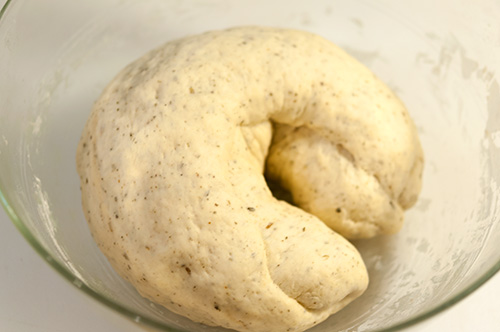
The wet dough aged overnight, this went a little longer, okay a lot longer. Twelve hours is a good target. 

The yeast will go as far as it can go and then slow down then stop even though its environment is favorable. It will attempt to consume its environment but languishing this way affords the yeast one way of reproducing, by budding, growing like a tree except in segments. But once the the dough is turned out onto a work surface and stretched then the yeast are redistributed and they suddenly find themselves in propinquity with a corresponding type and are afforded their sexy type of reproducing, that is, they can suddenly turn on their bad diploid selves from their languishing depleting haploid activities. 

But it looks like such a wet gooey mess, doesn't it?


In Mexico they make the best dinner rolls and I always marveled at their mastery, and now I have the secret.


That is to say I've internalized their strange ninja dinner rolls ways.

This is where you control the timing if you want to do that, say, narrow it down so that your guests are awestruck with your mad dinner roll abilities by presenting excellent hot rolls directly from the oven at dinner time.

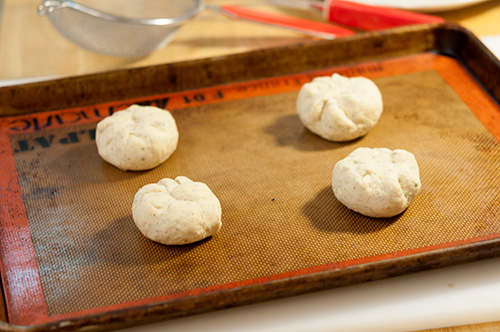
You decide when to shape them. There's no pressure for them to be puffy and presentable as these appear to be here, they can be loose and wet and floppy when they are inserted into the oven, so proofing them a second time is not so critical as it seems. However they cannot overproof at this point, so error on the side of short proofing them. And if your guests call and say they'll be late by an hour then your plan is dashed for on-demand presentation, or tell your guests, "Well, just forget it then!"


There was about an hour resting in the proofing box after being formed but it could have been as short as 20 minutes. There is not much difference between pre and post proofing. 20 minutes would not allow time for the yeast to do much of its diploid activity but it really doesn't matter. The air holes are already present and folded in the loose floppy wet dough balls. Intense heat will expand them once it reaches them, but the surface must be kept wet in intense heat for the network of pockets inside it to stretch.  If proofing in the box helps develop the air pockets a little before that then great, but this works well with short or long second proofing.  Just so you know, this is where you control timing again if that's important to you. 


The floppy wet dough balls are inserted into the torture chamber and steamed in there for  the first 10 minutes allowing heat to get to the center and expand the air inside the air bubbles and air pockets. The skin must stretch to accommodate all that internal expansion. It's like a balloon holding a thousand tiny organic balloons inflated with heat. To get that heat to the center fast it must be high heat. For the surface to stretch like a balloon it must be kept moist.


These are the tricks of the trade:

1) insanely slow proof 12 hours best, this is 16 hours

2) wet sticky dough

3) no punching. stretching and folding instead.

4) high heat

5) kept moist with heavy misting for expansion then stopped to crisp the  crust. 

Dinner rolls


The levain produces a sourdough loaf that is flavorful, very flavorful with fermentation, but not attractive. I do no like what the culture does to flour when it is done with it so a trick would be to never let it be done. That is, never let the culture be done with the flour or come close to exhausting it.

This technique does that. It uses the flavor of the levain without any emphasis at all on the yeast elements of the culture, that portion is taken over by a fast and reliable commercial single cell yeast. The two are combined with the aim of attaining the benefits of both approaches, natural leaven and commercial yeast.    


It's what people do who are not purists. But what of the weight, the crumb, crust, and taste?

The bread is excellent. It is both oddly aged and new, it has qualities of both, seriously, it is hard to pin down. Open crumb but not wide open, it toasts similarly to how the faster to rise white bread does but it comes out heavier and more substantial. Its flavor is nicely developed without being actually sour. I like the taste and the weight.

The dough is a lot easier to handle than stiffened and refreshed levain and more cooperative and forgiving. The finished loaf altogether easier to deal with. The crust is thin and delicate. I can see why people do this hybrid method, I always viewed it as cheating but now I am changing my opinion. It can salvage this otherwise difficult culture. 

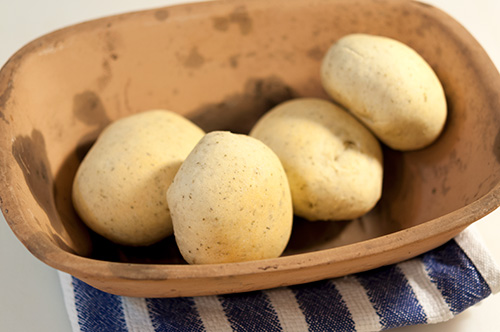
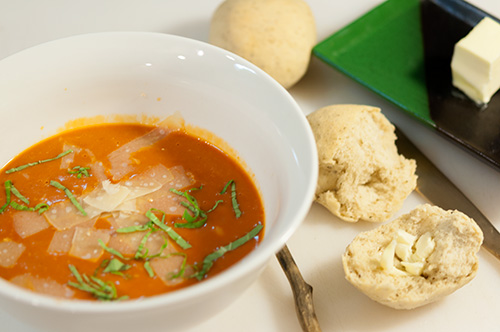
These are large for dinner rolls, they are mini loaves, actually, and substantial enough that one could be a whole meal. But why would you want that, so you load it with things and then cannot finish it. With simple olive oil they are impressively flavorful rolls. 

Baked on highest heat possible with heavy steam the first half. That is what causes the blister shown on the surface.

Dinner rolls 2


This is the second iteration of the trial runs for dinner party on Friday. Today is Tuesday. These rolls are 100% a/p flour with sage, garlic powder, and coriander. Apparently, I'm a nut for coriander and I do like sage. This test was to compare 100% a/p with 75% A/P + 25% whole wheat. These rolls experienced much more oven rise than the ww / ap mixed rolls shown in the previous post, all other variables are constant. 

The dough was started with 2 cups a/p flour whisked with salt and herbs, then one cup warm water was added started with 1/2 teaspoon dry active yeast and 1/8 teaspoon sugar. Even at 100% hydration by weight, the dough was still insufficiently sticky so another 1/8 cup water or so was added to loosen the dough. The dough was stirred vigorously but only for about one minutes. 

Twelve hours later the dough was turned out onto a floured work surface and divided into 8 segments. This turns out to be just the right size for dinner rolls or for slider type sandwiches. So, 1/4 cup flour for each roll.

The individual rolls were folded in thirds as customary loaves, then thirds again in the opposite direction, then  pinched completely, totally, absolutely sealed around the three open sides. 3/4 cup water was dropped into the oven via its chimney that exits through the center of a back burner. The hole was covered with an upturned mug to hold the moisture in the oven chamber as well as possible. The oven rise and the overall expansion due to intense heat caused each roll to break open at its seam. 

These rolls are perfection. No brag, just fact. They could be served with pride at any restaurant in any city in any country. ← Rhetorical device I just learned called epistrophe, repetition of words at the end of of a series of sentences or clauses. It's a type of conduplicato. It was big in the 19th century. 

So are these rolls insane or what? These are so going to kick ass on Friday. The best my friends can do is Pillsbury refrigerator rolls, which aren't bad, they're just not artisan. I can't wait to reaffirm my status as the most awesomest cook for a regular bloke that any of my friends know, and I'll be all, "Wut?," shrug. 

Dinner rolls


These rolls are a trial run for a dinner party that I am hosting on Friday. Today is Monday. The test is for quantity and for the effect of 25% whole wheat flour. 

Two cups flour total + 1 cup hot water produced nine dinner rolls. Eight would probably be a better size. 

The party is a dinner gathering for twenty people, possibly thirty. The exact number is presently unknown and probably will not be known. I always tend to overdo it with these things so my learning curve has to do with backing off from estimated quantity. I've never had too little and always end up with surplus, so part of the planning is to have plenty of disposable storage containers and paper bags to carry them. 

So three of these batches will do it.  

MATHS !

Four batches will assure people have at least one roll to take home with them, and who in their right mind wouldn't want that? Nobody, that's who not. 

I do not care for the effect of 25% whole wheat, at least not this whole wheat which is King Arthur. The bag I have is old. Maybe I should just toss it out, and maybe my own milled whole wheat will be different but I do not think I'll risk it. 

As for the rest of the dinner on Friday, at this point I have no idea what we're having and I am not the slightest bit perturbed by not knowing. I am possessed of just that much implacable equanimity and complete confidence. ← Possible self-delusion. 

Dinner rolls


The idea was for hamburger buns. The dough for each individual bun was stretched as a squarish pizza, folded in thirds, then stretched again, folded again in the rotated position, then again, so three stretches, and three stacks of three layers each, so nine internal layers. The layers were wet so they would conjoin during the second rise.  This resulted in dinner rolls slightly taller than perfectly appropriate for hamburger buns, but once a chap has some height on 'is buns it's difficult to go smashing them down then innit. 

Plus I've been called out for dinner tonight and I mustn't disappoint. So we'll just have these for something else and give the hamburger buns another go tomorrow. 


For a tiny batch. 
3/4 cup hot tap water
1 + 1/2 C A/P flour and WW flour combined approx 3/4 A/P to 1/4 WW. This is an estimation. In reality, the flour was added by the tablespoon until the water no longer took it up and the resulting dough was not a sticky mess in my hands. 
1/2 teaspoon sugar
3/4 teaspoon active dry yeast. This is a lot of yeast for this amount of dough, but I don't care. I thought I was in a hurry.
1/3 teaspoon salt added during folding
1/8 cup olive oil to paint the surface


The dough was kneaded entirely by hand, that is, it never touched the work surface until it was completely finished kneading. It was stretched out as a pizza then folded back into a wad, then stretched again repeatedly. The ball is shown on the work surface right at the point it is finished being kneaded and in the bowl for comparison with how much it rose.  


Due to the 1/4 WW flour, these rolls are slightly heavier than ordinary dinner rolls. They could work for hamburger buns just fine, but those hamburgers would then be more akin to sliders than to a customary hamburger. 

I must add, when I lifted the top off the improvised proofing box the aroma that struck my nose was that incredible slightly astringent alcoholic scent that one associates with fermentation. I think that is so amazing with such a tiny batch of proofing dough. It assures me that these rolls are going to taste great even though they were ripped out quickly, as far a bread goes. 

Oh, I almost forgot because I am rushing for dinner; these buns were baked on pizza stones with clay roaster portions for lids, either the top of the clay roaster or the bottom, it didn't matter which. Two roaster halves fit upturned on the square pizza stone but only one fit on the round pizza stone, so it worked out perfectly  for this batch, otherwise the oven would have had to preform double duty. It doesn't really matter that much because they do bake rather quickly anyway. 

Hamburger buns, dinner rolls


My buns are still better than your buns. They're firmer, they're more rounded, they're warmer, they're more open, they're tastier, and they stay fresh longer. SHUT UP! They ARE!

Here's how your buns can be as good as mine. See, I'm a giver. 

Take a moment and make yourself a biga, that's  Italian for poolish, which is French for pre-fermented dough. Sponge, if you like. That would be half the amount of total dough with a fraction of the yeast and none of the salt made one day in advance. Or half a day. Or overnight. Just do it in two parts separated by time

The next day add all the rest of the ingredients for the full amount of dough. You'll be amazed at the difference this one simple change will make. Take it from me because I'm a freak'n EXPERT!

For 10 buns that are 3.25 oz each. 

* 3/4 C warm water
* 1/4 Teaspoon commercial yeast
* 1 to 1.5 Cups flour. However much it takes to make a loose dough.
* Cover and set aside at room temperature.

* Time. The most special ingredient of all. No effort required. No watch needed. Use as much as you want within reason.

Next day: 

* 3/4 C warm water
* NO yeast. Not necessary. Therefore, t'would be possess'd with double pomp, to guard a title that was rich before, to gild refined gold, to paint the lily, to throw perfume on the violet, to smooth the ice, or add another hue unto the rainbow, or with a taper-light to seek the beauteous eye of heaven to garnish. Is wasteful and ridiculous excess. SO DON'T DO IT!  NOOOOOOO0000000ooo. 

Or go ahead if you want to.

* Add enough flour to stiffen the dough. As you proceed, occasionally remove a small portion and feel with your fingertips how the dough stretches. If the dough is too sticky, obviously add more flour. If the dough is too stiff, then you overdid it with the flour so correct by drizzling water. Continue in this manner until you achieve the desired ratio of liquid to flour.

* 3 Tablespoons olive oil
* 1 level teaspoon kosher salt (or less table salt)

Today, I formed the dough into little balls and they rose separately. This required  two overturned storage tubs. When the balls expanded, but didn't quite double, one by one I flattened the dough balls, which at this point are quite tender, and folded them in thirds. then stretched the folded dough again and folded it in thirds again, maintaining the stack as if it were a very thick puffy blanket, now folded into a pillow shape. Pinched the edges. Then tidied the pinches.  This treatment does not completely smash the dough nor does it completely obliterate the bubbles that formed. All it does is prevent GIGANTIC bubbles from forming and wrecking a sandwich-like bread crumb. Small bubbles okay, Huge bubbles not okay, for this application. For artesian bread and baguette types, batons, boules and the like, open crumb with large holes is desirable, but not here.

That's all you're having on the theory of bread dough for buns. 
Blog Archive