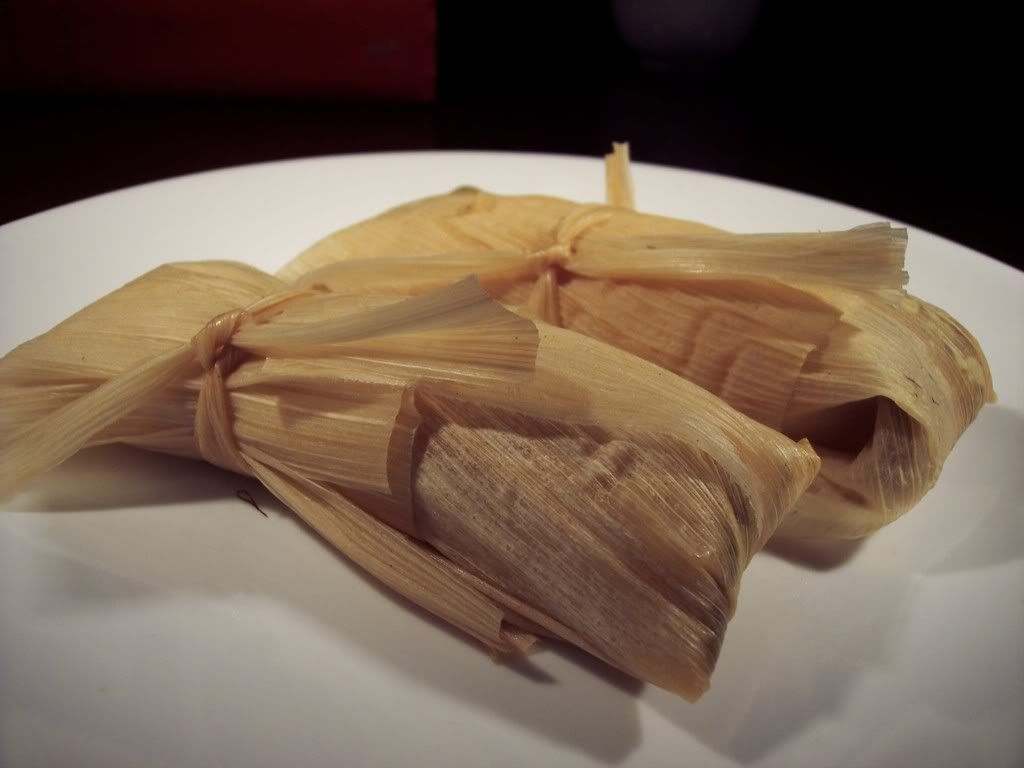
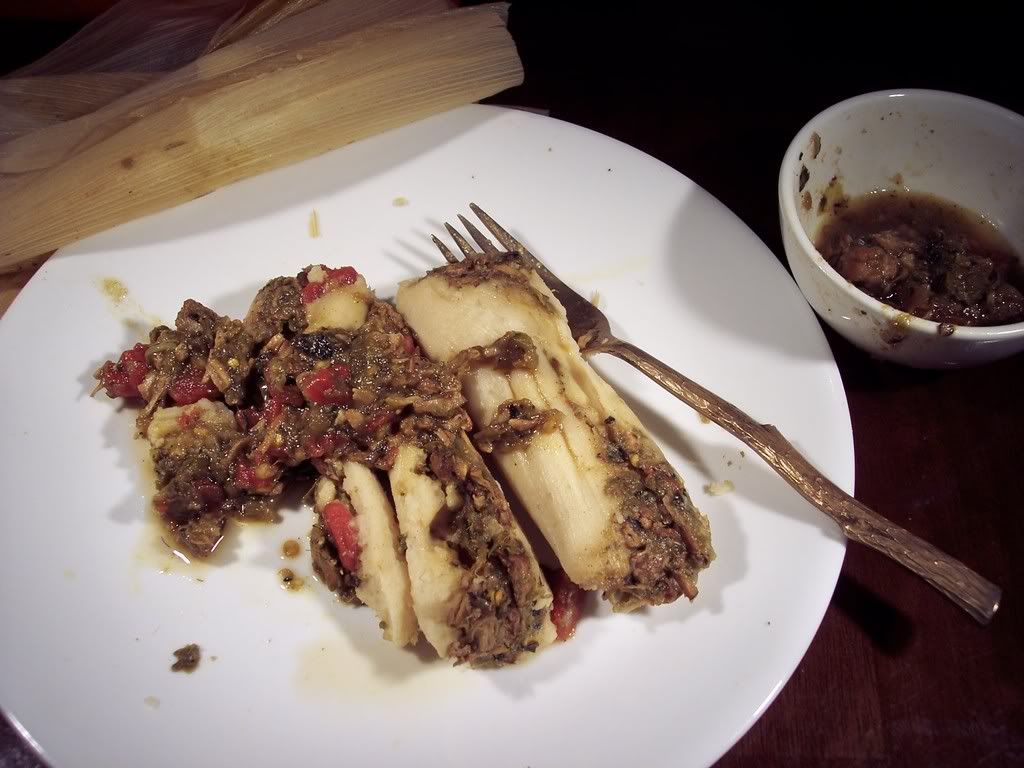
This tasted like crap. And I
mean it.
There is something wrong with the masa harina, stored too long unrefrigerated. It's carrying an unpleasant metallic taste. I threw out the entire batch which was about 20 tamales and tossed the sack of masa harina.
And that's a shame.
Update: I see this page ↑ is getting a lot more views than it deserves. Here is another post on the same subject. These tamales ↓ came out much better because the masa harina (treated corn flour) was fresh. Plus the new post is more informative.
Tamales can be anything; beef, chicken, pork, lamb, ostrich, iguana, howler monkey, prairie dog. Okay, maybe not so much those last four. All the tamales I made previously were chicken, and these initially were going to be chicken too but I changed that idea when I opened the freezer and saw a gigantic pork roast sitting there on the bottom, all forlorn and neglected. I thought the roast had a bone in it, and I wish it did have one because that could have contributed mightily to the flavor of the broth. Alas, no bone. It must have been one of those fancy-pants up town roasts. Whatever, it worked.
My largest pot is too small so the meat was seared in two batches. This is half.
Water is added plus a bunch of Mexican type spices. Mexican oregano, whole cumin seed, whole coriander seed, whole black peppercorn, bay leaf, sea salt. I held back with the intention of tasting later and supplementing if necessary but additions were not necessary. See? Now that there is what you call maturity! I no longer go dumping everything I think will work until at last I succeed in totally overdoing it.

These are all old chiles I had in a box. The red ones are marked "hot" but they are so old I suspect some of their intensity is lost to the atmosphere. There are five different types, all with different flavors and heat intensities. They were not tortured in a skillet as usual to activate their oils but rather just dumped into the water to cook with the pork for hours, along with an onion, quartered, and three large cloves of garlic, smashed to activate its sulfides. I also added a small bag of sun-dried tomatoes. Seeds rattling around everywhere. That explains why there are so many chiles around here, there are seeds all over the place. I can't get rid of them all. I think Mexican people just give up and leave a lot of the seed in there. It's making me neurotic.

The pork is cooked in seasoned water with chiles for hours. The liquid is allowed to cool with the pork still in it. If the pork is removed while still hot, it tends to dry out. So it cools in the liquid and is then pulled apart. This exposes more surface area, and the fibers act as mop that absorbs more liquid than it could otherwise hold.
The liquid is processed separately into a smooth sauce. The sauce is taste-tested to see if it needs correction. It was different than I expected, and I did expect to adjust with more chiles in powder and flake forms, but I decided I did like the flavor a lot. It is mild and sweet and with lovely and appealing expanded chile dimensions, but virtually no heat. It would appeal to anybody, I think, even children. I do not understand where this chile sweetness comes from. I did not add any sweetener.
Processed liquid is added back to the pork, as much as it will take. I want the tamales to be moist.
It is unusual to roll tamales with strips of chiles, but that is what I am doing with this batch. I could have just as easily bought a can of diced chiles and added them directly to the pulled pork, but I wanted each tamale to have a strip of chile as a surprise. These are mild.
Masa harina is same thing that corn tortillas are made of. It is corn meal treated with an alkali. This treatment that the corn undergoes with slacked lime (the chemical, not the fruit) loosens the outer husk of the corn and softens the interior making niacin available along with contributing calcium. Masa harina is a fine powder that readily re-mixes with water or any other liquid, here, some of the pork sauce, and water, along with butter because I didn't have any lard. Yes, LARD. I would have used it if I had any, and I thought I did. I was unwilling to go back to the store just to get lard, but it is an authentic ingredient. Can you imagine -- butter substituting for lard?
I saw Bobby Flay make these, or something like them, on Iron Chefs, using regular corn meal. At that moment I thought, "Oh, no. That's 100% wrong." The judge, Jeffrey Steingarten, bless him, picked up on it too and questioned Flay incredulously. Flay bullshitted his way through the questioning like a badass know-it-all, "Yeah, they use some kind of mix, but sometimes I like to use regular corn meal for its flavor." but it was clear he did not fully appreciate the joy and superiority of Masa harina and its contribution to Latin cuisine, much less its nutritional value compared to ordinary corn meal. Further, the process of treating grain with alkali is called nixtamalization, thus tamal, so wrapping a corn husk around a filling smothered in corn meal does not make a tamal without the nixtamalization. It would be simply polentization, or more prosaically, gritsifcation. Man, something is wrong with this spellcheck thing, it's suddenly putting red lines under everything.

This masa (dough) is pink because the pork sauce added to it is red.
Corn husks can be found at any grocery store here in the West and the Southwest. If you cannot find them, you can probably use banana leaves, but it will not be the same, and that's a shame. Some pages online say to soak the husks overnight. That is probably a good idea. I soaked mine for a few hours. They are always a little stiff. They are also irregular. Some work better for wrapping than others.
Hahaha, concha ↑ means shell.
There is nothing worse than a tamale that's all masa. Wet masa in this application equates to a wet tortilla. You wouldn't serve a tablespoon of filling on three corn tortillas, so the same idea applies with tamales. A very thin layer is applied to the wet husk.
Surprise! Chile. Now, who wouldn't be filled with glee and wonder to find a chile tucked inside their tamale? Nobody, that's who.
Most tamale cooks fold their tamales and leave one end open. I must admit that is an attractive idea. But I will be freezing most of these so they must be closed. At least I think they must be closed. So mine get tied with a strip of husk. Very Asian looking, don't you think?
Check 'em out, Checkemouters -- a veritable wall of tamales.
Steamed for twenty minutes in two batches. My pot is too small to hold them all.
Here is another very similar sauce you might find useful.

Buenos dias. Pictured above are enchiladas held over from yesterday refreshed and moistened with a new red sauce all their own just for them. So now these enchiladas are doubly sauced up, doubly enchilenated. This sauce is specific to enchiladas but I can imagine it accompanying tamales, burritos, chile rellenos, tacos, huevos rancheros, pretty much anything. There is a green version too made with tomatillos and different chiles, but this one is red.
Ancho means broad, wide, width, roomy, capacious, breadth, deep, loose, etc., you get the idea. Arbol means tree, a plant with a woody stem that branches outward. Frankly, if you ask me, anchos could just as easily been named arbols, and arbols do look remarkably like Japonese or any of the other small long red chiles. In my view there is very little difference between the small long skinny red ones especially when you take into account cross fertilization, hybridization, and the ever important terroir. At any rate, these two chiles are red.

The anchos look black, I know, but they are actually a deep red.
The chiles are rinsed, rehydrated, torn open and de-seeded. They are patted dry and toasted in a hot pan, turned continuously for about five minutes to completely soften and to excite their molecules. You should get a nice big whiff up your nose, and this will tell you that you are right on track.
Take care they do not burn.
The usual suspects. This is Mexican oregano ↓ and whole cumin seeds. Right off the bat we are presented with something of a paradox. Oregano, ore, mountain, gano, joy, Greek for "joy of the mountain," so by stating Mexican oregano one is literally saying Mexican Greek joy of the mountain, and that's ridiculous. Here's how that silliness came about. When the Spanish arrived and began checking out all the herbs and spices the New World had to offer, they encountered many plants that reminded them botanically of the plants with which they were familiar. So a lot of things are botanically misclassified, basils that are not basils, oreganos that are not oreganos. Mexican oregano is stronger than Greek oregano and I prefer it. Real Mexican oregano looks like tiny florets. Have a look-see.
A couple of small tomatoes, not shown.
Six cups of water and cooked for about 15 minutes until fully softened. Then blended.
Do not skip this step ↓, the straining contributes significantly to the mouth-feel.
Strained back into the pot and cooked another 15 minutes to completely wed the flavors into a single united entity. At this point, the hot viscus liquid is a dangerous sputtering fumarole of molten magmata spitting its lava in every direction onto all surrounding surfaces. A lid, at least of aluminum foil, is required for safety.
Salt, of course, to taste. I added Celtic sea salt because I appreciate its high mineral content, which displaces sodium. I think. So the sodium is slightly lower. Plus there is no obvious iodine taste, although iodine itself is present.
At this point I questioned, "How can this possibly be any good when it is just dried chiles and a few alliums? Huh? How?" Surely it would need more acid than just a few small tomatoes, and that must be counterbalanced with something sweet. I got myself ready to add something with alcohol, possibly something completely unMexican. I was prepared to make adjustments.
Nope. It can not be improved. I like it just as it is and so will you. The anchos, originating as they do from Poblano chiles have hardly any heat at all. They are two steps hotter than bell peppers on the Scoville scale but they possess outstanding flavor, concentrated by dehydration. The heat comes from the much smaller and fewer arbol chiles. They could easily be doubled with no ill effect. In fact, a touch of habanero wouldn't hurt either. But this sauce is fantastic just the way it is. I do not understand where its own sweetness comes from nor its own tartness, but those characteristics are there. I marvel. I will freeze a portion for reserve, and keep another portion refrigerated in a small jar. This sauce is well worth the effort.